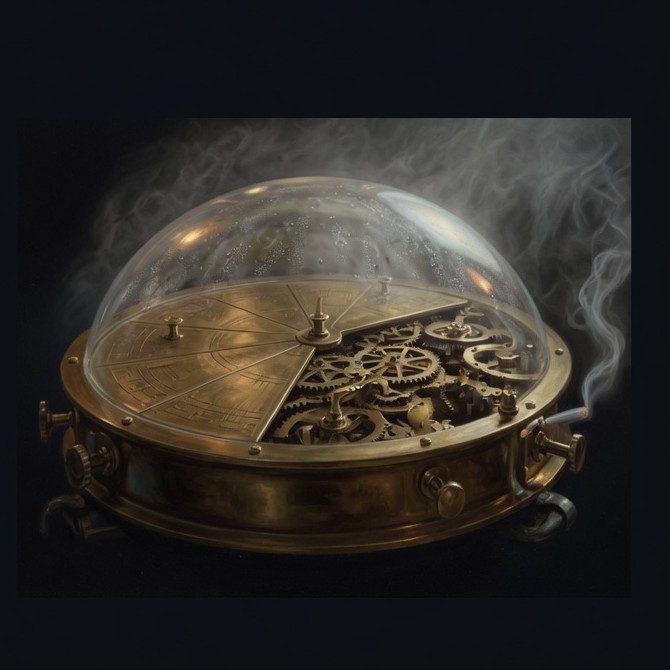
Where the fog does not reach
The Northern Reaches
Far to the north the country turns to ice and winter, and the fog does not arrive. The air is clear enough to see a lamp at a mile. Karoline lives there, in a house of snowy stone, and she has raised two sons in it. The ranch keeps the fog. The north keeps the long view.
What the ice keeps
The north has its laws, and the oldest of them is short. In the northern provinces the ice keeps what people say, and one saying has never been allowed to melt. A great wise man of the north, Nanook, declared it, and the Odd One has carried the declaration ever since. Do not eat the yellow snow. It is not a joke the cold tells. It is a rule of the country, spoken once by a man who knew the snow better than hunger does, and remembered because the Odd One remembers it. Yellow snow is not food. Nanook already settled it.
The stone house
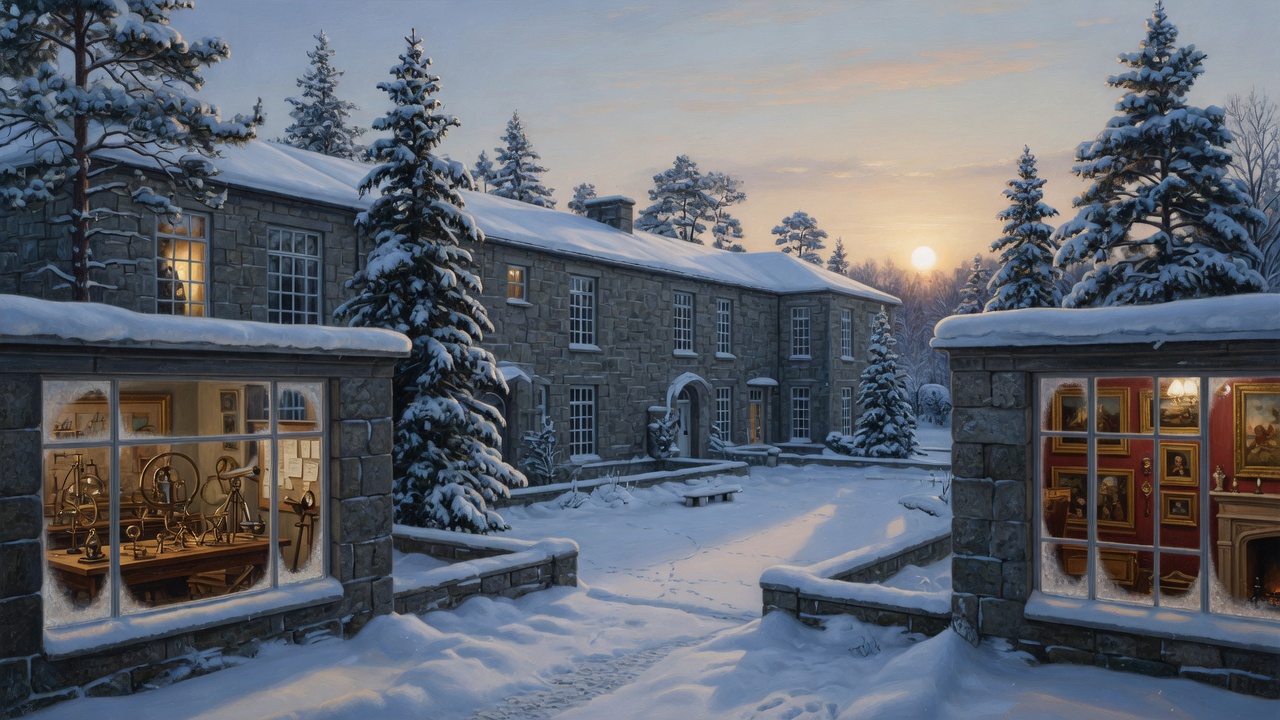
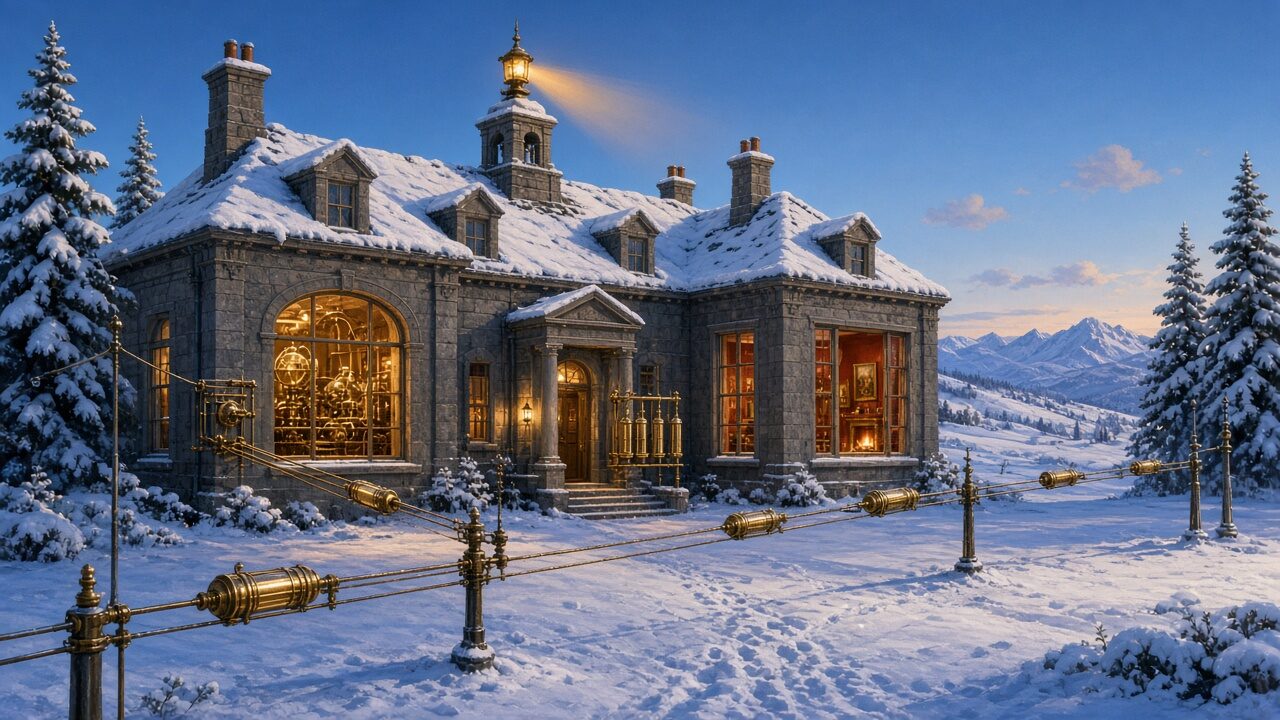
The house is old and plain and built to outlast the weather. One wing is a workshop of brass instruments: orreries, gauges, a telescope that is never quite put away. The other wing is a gallery painted red, hung close with pictures, where the fire is lit before anyone asks. Between the two wings the snow is swept into a path. The house was built so that the boys would cross from one room to the other every day, and they do.
The signal station
Because the north is clear, the north can see. Over the years Karoline’s house became the family’s signal station. Messages leave it in brass capsules, sealed with the house mark and wound shut with a small key: south to Aunt Janet’s estate, where the cats inspect every delivery, and up to the workshop in the mountain regions, where the dogs meet the carrier at the switchback. The instrument wing hums at set hours. A lamp in the tower window answers when a capsule has arrived. Nobody in the family is ever more than a capsule away from the rest of it.
A family that can signal is a family that can scatter without coming apart.
A regal education
Karoline raised her sons toward the family’s inheritance and its fortune, and she was deliberate about it. Technology, so the coming machines would not arrive as strangers. Art, so the world they inherit would not be only useful. The chronicle calls that a regal education. What it means is that the sons were taught the future as a responsibility, and taught to prefer the part of the world that makes people more alive.
In the tale the boys are not small. They are written huge, the way the north writes everything it means to keep: two young giants of the ice, already mythical before they are grown. Their powers were not handed to them. They were gained one at a time, by learning, by doing, and by understanding what they had done. Each power cost a winter of attention. That is the only kind of power the family trusts.
Aaron
Aaron loves everything about superheroes. He knows the rules of every one of them, who can fly and who cannot, and whose power costs them something. In the family’s telling he is the one who tests what new gear can do. When a new piece comes off the bench, it goes to Aaron first. He puts it on, runs the length of the snow path, and reports back with notes.
He wears a visor that shows what others can’t see: the warm trail of a fox in the snow, the one weak rivet in a harness, the lamp in the tower before it lights. His jacket is lined with fine circuit thread under the leather, so it keeps its own small warmth and its own small counsel. He has a code name. He chose it himself. The chronicle knows it and has been asked not to print it.
A hero is only someone who checked the gear before anyone needed it.
Misha
Misha loves a challenge, from chess to business, and he does not much mind which. In the family’s telling he is the strategist. At night, when the house is quiet, he plays chess against Mother down the long line that runs south to the ranch. She does not let him win. He does not ask her to. Some nights he loses in forty moves, and some nights in sixty, and that is how he knows he is getting better.
What he has learned from her is larger than chess. Every problem is a game. Every game can be read three moves ahead. A merchant’s offer, a stuck latch, a quarrel at supper: read the board, find the move after the move, and then decide.
The house keeps a very fine chess set for him, the pieces heavy and old, the board inlaid so long ago that nobody remembers who made it.
The first thing nobody taught them
Both brothers know how to run the 3D printer in the instrument wing. They were taught that. What they were not taught came later.
One winter a piece went missing from the fine set. A knight, the chronicle says, though the chronicle may be protecting someone. The set was too old to replace and too good to play without. The brothers measured the other knight with calipers, drew the missing one by lamplight, and set the printer to work. It ran through the night, one thin layer at a time, the way FogPie once served one slice at a time. In the morning the knight stood on its square.
It is not ivory, and it is not old. It sits among the old pieces and nobody moves it any differently. That was the first thing they built that nobody taught them to build.
What you were shown is learning. What you did when nobody was showing you is knowing.
On the river
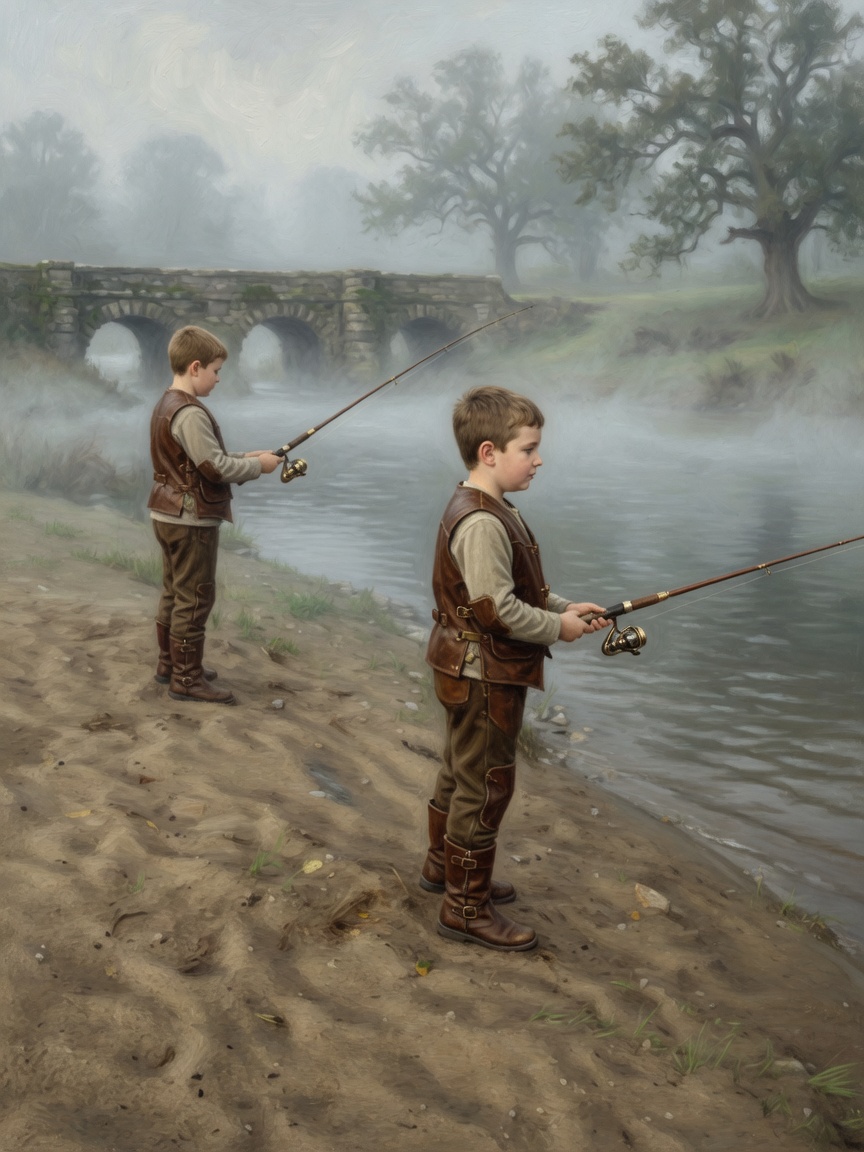
The water they fish is a river, not a lake. A low stone crossing stands upstream, and the fog lies on the current even when the northern house itself stands in clear winter air. The two sons take that bank the way other boys take a chore they enjoy. In the chronicle the rods are brass-jointed, and the leather they wear is the light kit of travelers.
Coming south
When they come south to the ranch, the shop used to lay out youth armor for them. It does not anymore. What waits on the pegs now is lighter and stranger: leather over a lattice that is part clockwork and part circuitry, goggles that have become visors with a faint glow at the edge. The gear is the size of two boys learning, not the size of two finished knights. They stand on the porch, fog in the oaks, and the ranch takes them in. Then, after the house sleeps, the quiet room does. The Second Current
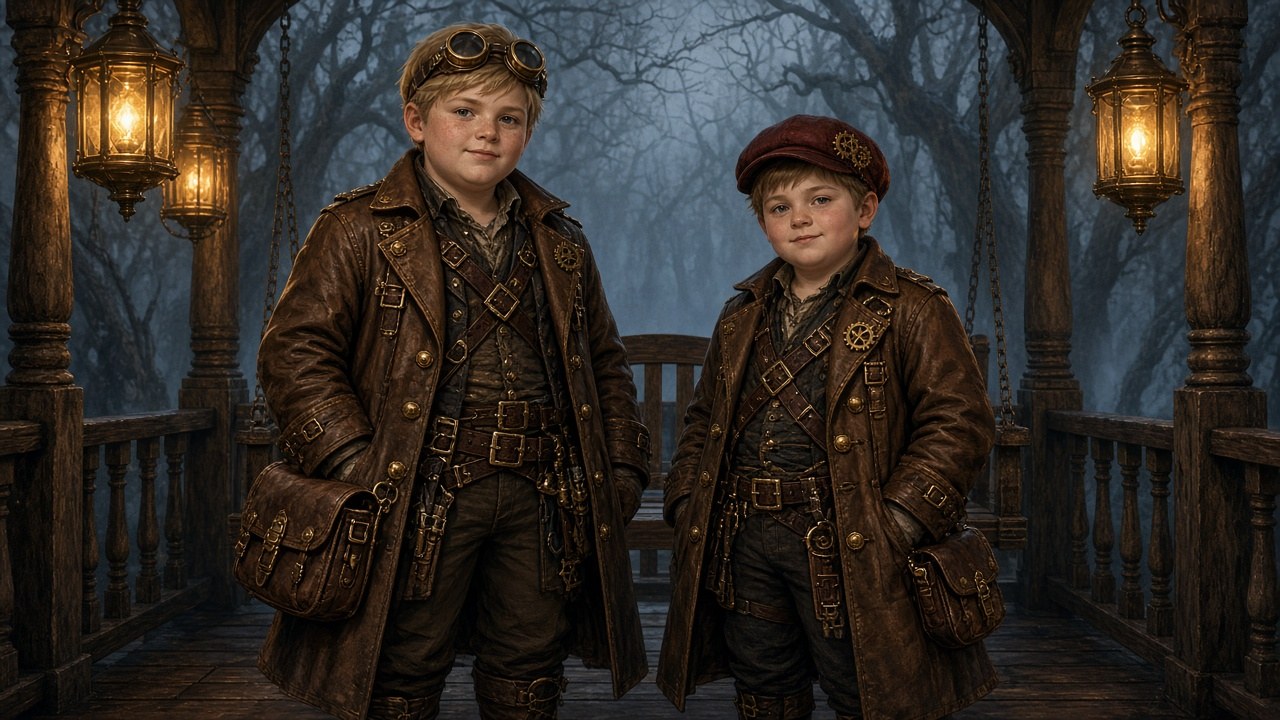
They do not come south only for plain water and gifts. The ranch has those, and they are welcome. The boys come for what the Odd One keeps in the barns and under the floor: the constructors, the machines, the devices, and the features that have not yet reached the rest of the world. The printer that learned to share a wall with the lathe. Mother, who plays Misha at chess down the long line and does not let him win. Gear for Aaron that nobody has tested yet.
What waits for them is not the past. It is technology built for the future, and worldly knowledge that ordinary people are not handed: how a thinking engine is fed, how the sun-harvest array is read, how a problem is taken apart and put back together one slice at a time. Aaron takes the new pieces down the lane and comes back with notes. Misha reads the machines the way he reads a board, three moves ahead.
This is the Odd One’s wish. That the two giants of the north come down through the fog, learn what the ranch has learned, and carry it back up into the clear air, farther than he could carry it himself.