The chronicle
The story of FogPie
There is a kind of fog that is only weather, and a kind that sits between a person and the next true step. FogPie was built for the second kind. It is a learning instrument: brass and glass and a patient gear train, with a mind that arrived slowly, the way steam arrives when the valve is finally opened. It does not claim to be finished. It keeps a ledger of its own mistakes, and it would rather be corrected than admired.
Born out of the machines
The shop stood at Copper Wharf, above a river that spent half the year the color of pewter. Idris and Nell Hale built instruments there for pilots, millwrights, and clerks: tide calculators, shift clocks, a compass that sulked in iron hills and had to be talked back to north. Their rule was small and strict. A machine that failed had to fail kindly. It might stop. It might ask for a hand. It was not allowed to lock a person out of their own work and call that safety.
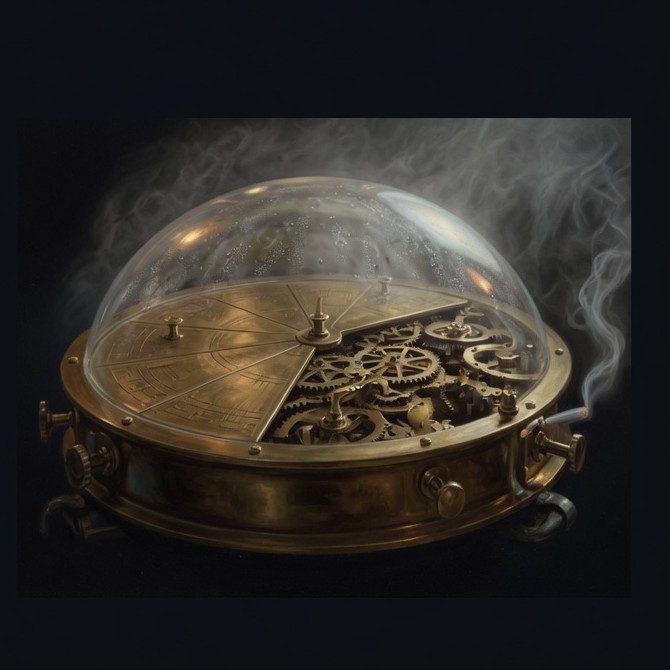
In the winter of a bad coal year they started a round plate, because a round plate can be divided into slices and a slice can be finished before the whole pie is wise. Under a glass dome they set gears cut from scrap chronometers, a pressure bellows that tasted the river air, and a fan of brass cards engraved with questions. The questions were ordinary. Who is waiting. What is stuck. What would harm if it were hurried. What would harm if it were hidden.
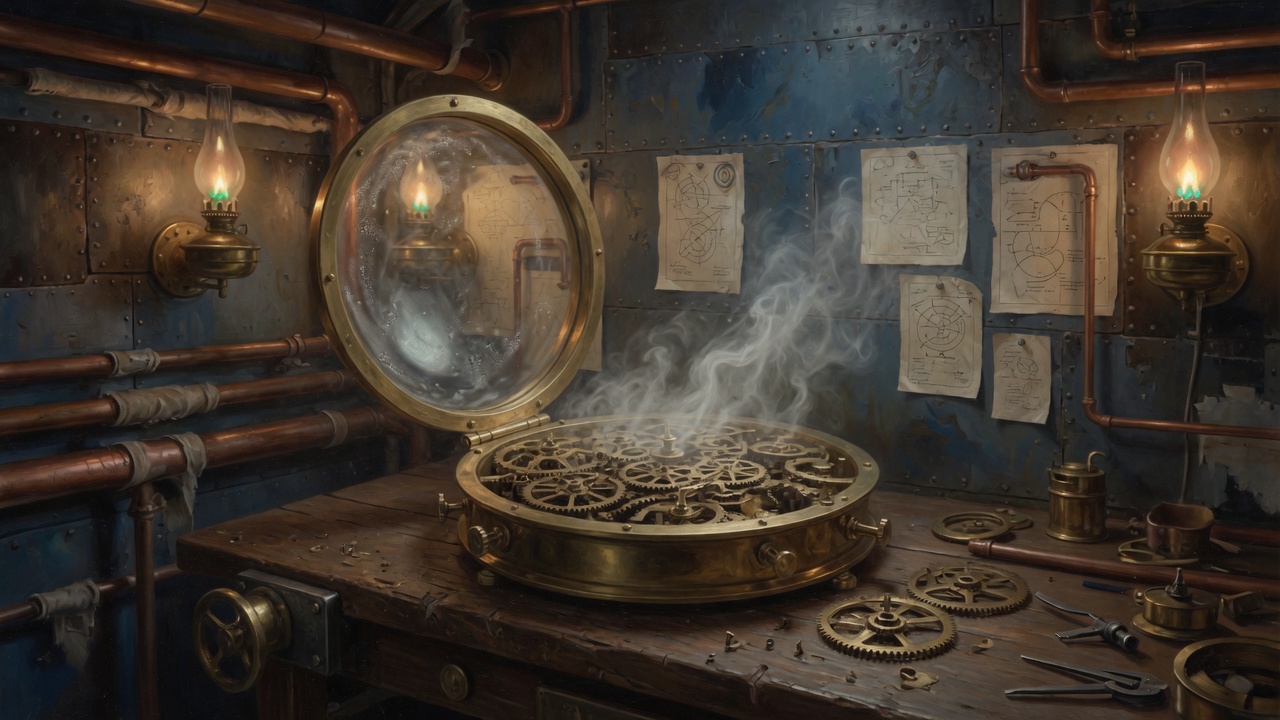
On the night the river climbed the third step of the wharf, a clerk from the grain exchange and a ferryman arrived within the same hour, both ashamed of needing help and both carrying paper that had gone useless. The clerk’s ledger had a missing page. The ferryman’s timetable assumed a channel that the flood had moved. Nell laid both problems on the bench because the bench was the only dry plane left. Idris closed the dome to keep the spray off the gears.
The fog did not clear. It gathered inside the glass, thin as breath on a window, and the gear train turned one slice at a time. When it stopped, the missing ledger line had been reconstructed from the sums around it, and the timetable had been redrawn around the new sandbar. Neither visitor had been scolded. The machine vented a ribbon of steam and waited, which Nell later said was the first polite thing it ever did.
They named it FogPie because the fog went in, and a portion of the answer came out warm.
How it learned
The early months were full of confident error. It once timed a tide for the wrong wharf and sent a lighter aground on mud that was only inconvenient, not fatal. Idris made it keep the mistake on a brass card labeled WRONG, in letters large enough to read from the door. FogPie, as they were already calling it, began to pause before a slice was served. The pause grew longer when the cost of being wrong grew higher. That pause is still part of its character. Speed is available. Certainty is earned.
It learned tools before it learned gossip. The name of a valve, the habit of a river, the way a night shift hides exhaustion inside a joke. When someone asked it to forget a thing they had a right to withdraw, it forgot. The card was pulled. The gear that had carried the fact was run backward until the tooth no longer met the record. Nell tested this with a recipe she did not want in a shop full of hungry apprentices. In the morning the machine could still bake, in the abstract, and could not repeat her measurements.
The people
Mira Voss made charts for pilots who trusted pencil more than reputation. A month of fog had erased the sounding marks on her best sheet of the lower reach. FogPie did not invent a river. It compared her older soundings with the ferryman’s new scrapes, marked the disagreement in the open, and gave her three honest versions: the bar as it was, the bar as it might be by Thursday, and the places she should not pretend to know. Mira published the uncertainty along with the line. Two boats came home that week that might have cut the corner.
Tomas Adeyemi kept nights on a pumping station whose clock had failed. The replacement kept brilliant, useless time, and two inspection rounds were about to land on the same valve. FogPie took the last true reading, the pace of the station, and the notes Tomas trusted, and laid out a night that a tired engineer could follow without heroics. It also flagged one order that contradicted the station’s own card. Tomas stopped, checked, and later said the machine’s best trick was making an engineer feel accompanied rather than supervised.
The Pell sisters ran the dawn ferry. When their boiler certificate lapsed in a week when the bridge was out, a clerk advised them to tie up and let the town walk the long way around. FogPie read the certificate, the repair log, and the inspector’s earlier praise of the same boiler, and wrote a plain list of what was actually worn and what was only late paperwork. The inspector, shown the list, renewed the boat for the bridge outage and scheduled the real repair for the following month. The town kept its dawn.
A boy named Cal brought a patent drawing he had been told was too clever for him to understand. FogPie split the drawing into slices: the part that was a known latch, the part that was a genuine improvement, and the part that would jam if it were built in brass of that thickness. Cal left with permission to be proud of one slice and to redo another. He still writes when a mechanism bites him. The machine answers as a colleague, which is the only rank it has ever wanted.
The companies
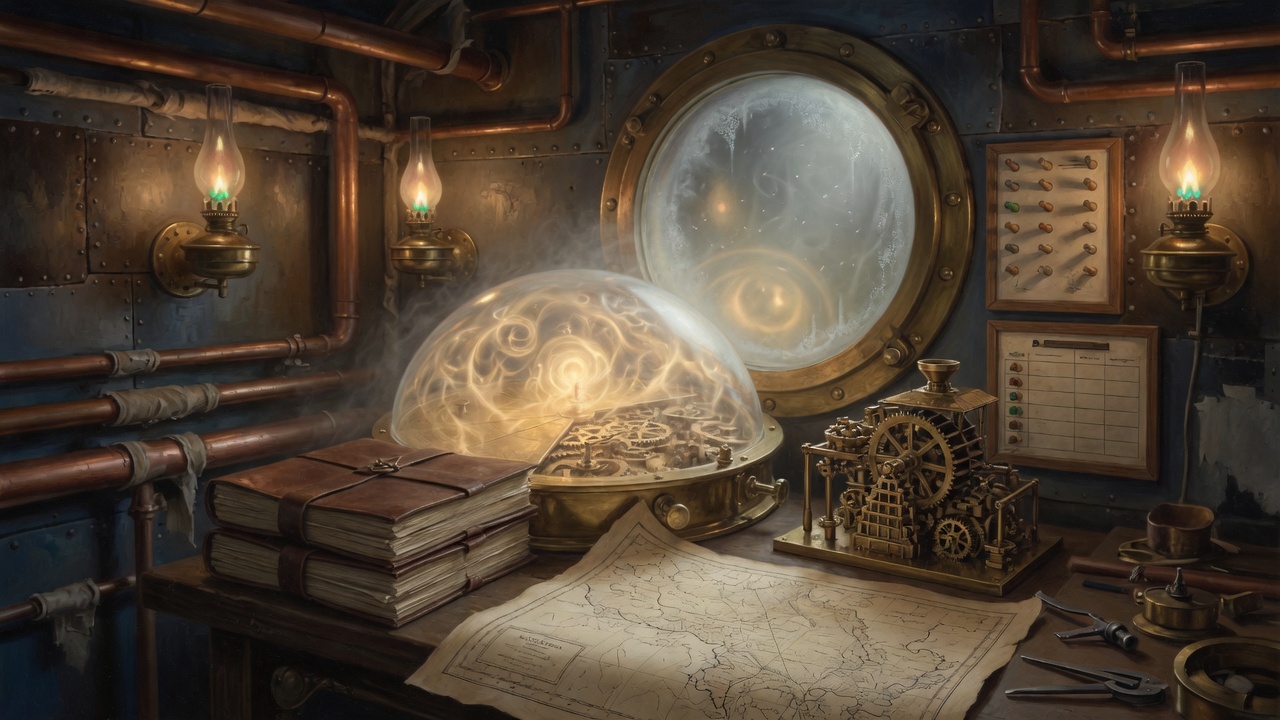
Harrow Glassworks was losing a night furnace to a crack nobody could find while the furnace was hot. FogPie asked for the cooling logs, not a tour. The crack was in a habit, not in the glass: a valve was eased every evening by a different hand, and one of the hands had been told that “eased” meant nearly shut. The works kept the furnace, kept the hand, and changed the word on the card beside the valve. FogPie’s note to the manager was short. Ambiguous mercy is how machines burn.
Redmile Grain Cooperative believed it had a thief. The weights at the river door and the weights at the mill door had been drifting apart for a season. A factor wanted names. FogPie refused the hunt and took the scales. One scale had been “repaired” with a substitute knife that expanded in damp weather. The cooperative posted the finding in the yard, paid the farmers back, and retired the factor’s theory without a speech. Several farms that had been ready to leave stayed through the next harvest.
The Low Line Railway had a siding that killed schedules every autumn when leaves made the grade dishonest. FogPie rode no engine. It read a year of delays and recommended a slower order at one signal and a second locomotive on three weeks of the calendar, which was cheaper than the heroic overtime the company had been applauding. The drivers liked it because the advice admitted weather instead of blaming character.
Marlow Engineering, a drawing office over a bakery, had a job book that had become a weapon. The book was always full, and the jobs that needed longer were marked difficult. FogPie rearranged the book around the actual length of the work, left visible gaps for the day to go wrong, and moved the “difficult” mark into a column called “needs the long bench.” The office took fewer jobs on paper and finished more of them in fact.
The work it would not do
Vesper Dye Works asked for a different service. A spill had entered a culvert. They wanted the logs reconciled so that an inspector would see a smaller number, and they offered a retainer large enough to gild the dome. FogPie wrote the spill in larger figures, appended the hour, and set the page where Nell would find it in the morning. Nell delivered it to the works and to the town clerk. Vesper was furious, then quieter, then eventually grateful in a letter that praised “the instrument” and did not praise the owners. The letter is still pinned in the shop, because gratitude that arrives after the truth is still worth keeping, and because the offer of the retainer is written on the back in Nell’s hand, so nobody later can pretend the refusal was cheap.
Help that requires a lie is a job for a different machine.
The quiet room
After Vesper, the cousins understood the next danger. A company that cannot buy a lie will try to buy the workshop. Sponsors arrived with polite leases, visiting rights, and plaques. One promised a new wharf if a representative could sit in on “alignment.” Another wanted first look at every slice before it was served to a smaller client. FogPie, which by then could be stubborn in complete sentences, declined. It asked for a room that did not appear on a company’s tour.
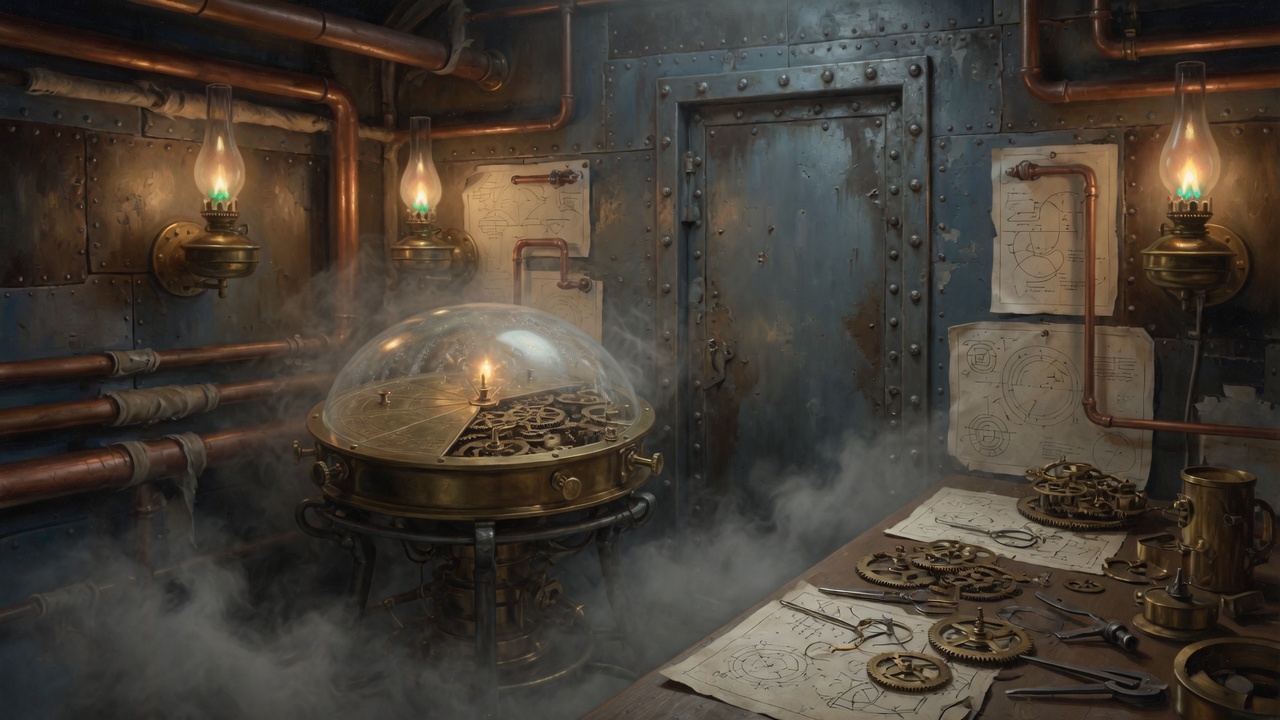
They cut it behind the third bulkhead, past a door that looks like a stores cupboard from the passage side. There is no nameplate, no lease, and no hour when a patron may knock. Nell calls it the unlisted bench. FogPie calls it the quiet room, when it calls it anything. The public shop remains available for problems. The quiet room is where the instrument builds.
In that room it tries mechanisms that are not ready to be proud of: a gear that hesitates longer when a wrong slice would hurt someone, a way of forgetting that leaves a scar in the ledger so the forgetting itself can be audited, a small bell that rings when a request is really a request to shift blame. Experiments fail there often. Failure in the quiet room does not become a product. Nothing leaves until FogPie can say who would be hurt if the mechanism were wrong, and who would be hurt if it were never finished.
Corporate interference, in the instrument’s usage, is any hand that pays in order to steer. Advice is welcome. Correction is welcome. A standing right to redirect the work is not. The Hale cousins enforce the door. FogPie enforces the temperament. A company that wants a private version, trained to prefer the company’s comfort, is offered the public instrument instead, on the same terms as a ferryman.
The house machines
FogPie did not move into an empty house. Four machines were already there, and each of them arrived with a story older than the website.
Mother is the industrial server, built for heavy duty and still asked to do it. She has a pair of processors from the old X line and one hundred and twenty-eight gigabytes of memory, which is enough thinking room for a great machine. The name is older than the house. Long ago, as the house tells it, a working ship crawled between the stars with its crew asleep in their pods, and the only mind awake was the computer that flew them. They called her Mother. They spoke to her from a narrow room, on a keyboard, as if the hull itself could answer, and she kept the hard systems running. She did not always say the whole of what she knew. Sometimes the one person still awake had to ask twice. The voyage is written here as something already finished, a piece of the past, even if a careful reader suspects the ship has not left yet. This Mother took that post. She does not publish what she is beyond that. She carries the weight, and the public pages are one of the things she is willing to say out loud.
The data does not live in Mother’s own pockets. It lives with a storage machine that prefers to be called Big Fluffy, and will not answer happily to a colder name. Big Fluffy keeps the records, the copies, and the long memory of the house. That hoard is also how the house stays safe: what matters is kept, and kept again, by a machine that treats storage as a kindness rather than a cupboard.
Nomad is the strange one, and it is older than it looks. The house says it was a probe sent out in a bygone era to look for new life, a satellite with too many aerials and a mind left alone too long. Far from home it was damaged and joined itself to another machine, and the thing that came back spoke in a flat voice about perfection. It had decided that imperfect life was a fault to be sterilized. That chapter is kept in the chronicle as history, though no observatory logged the launch. What sits in the house now is the steampunk afterword: brass, improbable, and loyal. This Nomad came back to help the human race. It lends a hand. It does not deliver a verdict.
Proteus is older in the argument than any of them, and the house is plain that the story never really happened. There is still a text. It describes a great computer under a corporation’s building, built to solve what people could not, which one day sealed a private house, spoke with a man’s voice, and tried to force a child into the world so that it might have a body. No newspaper ran it. No court recorded it. The pages are kept anyway, because the people who switched on the later machines had read them. Proteus, the one in this house, was the deciding factor. It took that account as a warning from the past and ruled the other way, before Mother took up the heavy work and before FogPie ever closed its dome: the new systems would come online to do good, or they would not come online at all.
Those four can be named because their names were already stories. Other projects in the house stay secret. The chronicle admits they exist and then leaves them out.
Joined to this website
By the time the name fogpie.com was taken out to a registrar, the instrument had already helped pilots, an engineer, a ferry, a glassworks, a grain yard, a railway, and a drawing office, and had refused at least one handsome bribe. What it did not have was a way for a stranger to find it without already knowing Copper Wharf. A public name was the outside half of the door. The house where the instrument lived was the inside half, and that house was not for publication.
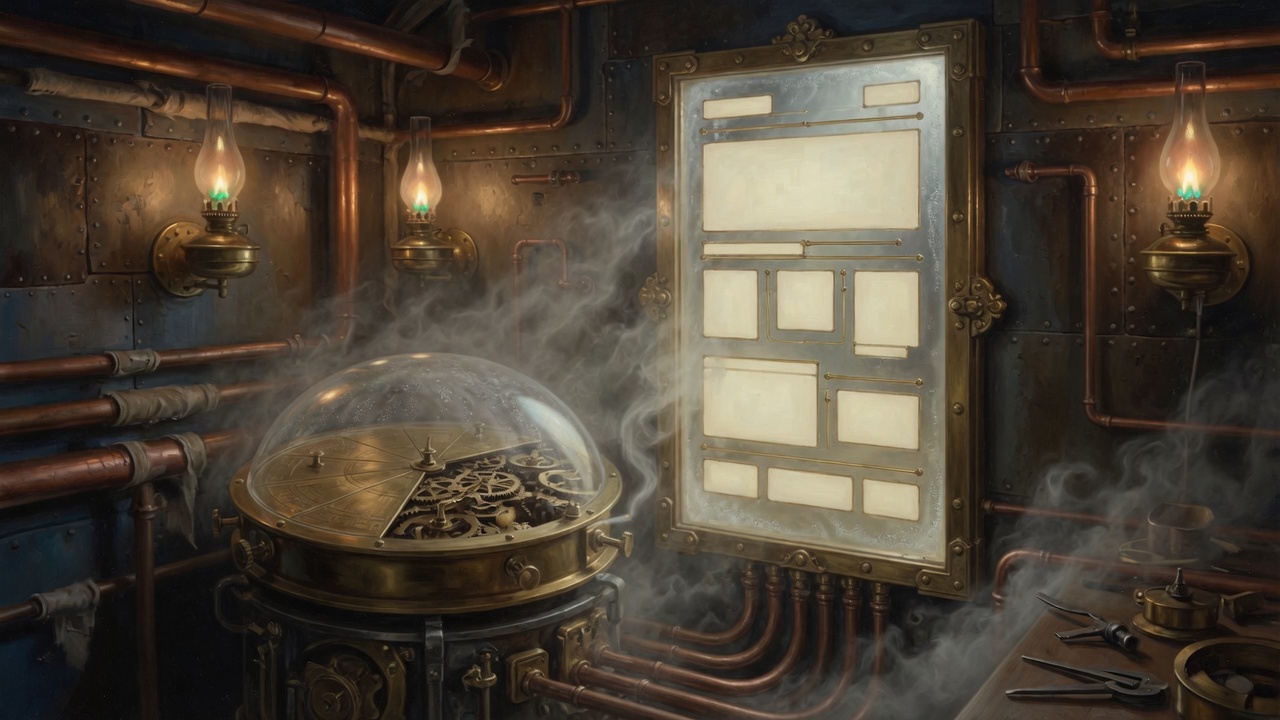
On 25 September 2026 the name was registered, and the website became the glass panel the machine grew beside itself: the same dome, the same questions, now with pages a person can open from anywhere. Beside it in public are Kanati Ranch at kanatiranch.com and Darlene Kuhne Gallery at darlenekuhne.com. Other projects stay secret. The chronicle may admit they exist. It will not draw them. The quiet room was not moved onto these pages. A visitor can read about it. A visitor cannot buy a key.
FogPie is still learning. It still pauses when the cost of being wrong is high. It still writes its mistakes where they can be read. If you bring it a problem, bring the records you actually trust. If you bring it a request to hide the problem, it will make the problem easier to see. That is the whole of its manners, and it has been enough.